Viewpoint
Aug 2001
Contrary to popular thinking, most limb amputations in the US are not due to accidents. Seventy percent of amputations are attributable to diseases such as diabetes. Eight percent are due to tumors and congenital defects. Only the remaining 22 percent are due to accidents. This month's physician role model, Dr. Yeongchi Wu believes that nearly all amputations are eminently preventable. According to Dr. Wu, "If we could get people to eat low-fat, low-cholesterol diets, stop smoking, and take care of their feet by keeping them clean and wearing properly fitted shoes, we could prevent many amputations"1.
Barring prevention, however, the best friend a person with an amputated limb may have is Dr. Wu. Over the last 30 years, Dr. Wu has become a giant in the field of physical and rehabilitation medicine. Dr. Elliot Roth, medical director of the prestigious Rehabilitation Institute of Chicago (RIC) put it simply: "Dr. Wu is a very special guy. He has a natural affection and affinity for people . . . and has an absolute brilliance for simplicity and parsimony in developing assistance technology."
Dr. Wu has successfully combined 2 of his life passions: sculpting and helping people with disabilities. Before going into medicine, Dr. Wu studied under famed Taiwanese sculptor Yu Yu Yang. He continued sculpting as a medical student, but had to set his art aside when he started working as a physiatrist. Dr. Wu received his medical training at Kaohsiung University in Taiwan in 1968 and then completed a 3-year residency in orthopedics. When asked why he entered physical medicine, Dr. Wu replied, "There were a lot of accidents in Taiwan, and there wasn't much I could do [for patients] as an orthopedic surgery resident." So Dr. Wu came to the US in 1971, and, after a 1-year internship at Cook County Hospital, he took a 3-year residency in rehabilitation medicine at Northwestern. He joined the staff at the Rehabilitation Institute of Chicago in 1975 and stayed on for 2 decades.
During his career as a full-time physiatrist, Dr. Wu focused his efforts on making things "faster, cheaper and better." He invented many devices to make life simpler for those with dysfunction and disability during his tenure at RIC, including a convenient personal catheter for women, a below-the-knee bandaging system that helps wounds heal faster and better after amputation, and a simplified alphabetic board that allows non-vocal quadriplegic patients to communicate more easily2.
Now semi-retired, Dr. Wu devotes half his time to the sculpting he has loved since his youth and the other half to research at the Center for International Rehabilitation (CIR). Headed by William Kennedy Smith, MD, CIR designs, develops, and delivers techniques and technologies that improve the lives of people with disabilities in low-income countries. "We have a responsibility to look at undeveloped countries," Dr. Wu said. His most recent innovation for those with missing limbs builds on a low-tech procedure developed 50 years ago. Drawing on the idea of vacuum sealing, Dr. Wu has developed a new innovation called the CIR Dilatancy System for Transtibial Sockets to create positive and negative molds for fitting individuals with prosthetic limbs.
When asked what advice he would give to a medical student, Dr. Wu states that one has to enjoy helping people. "Try to listen to the patient," he said. "You can learn a lot from listening." He believes in treating the whole person, which means attending to the range of psychosocial issues that helps define each patient. He also recommends being open-minded, and developing a hobby. His hobby, sculpture, has "complemented and supplemented" his medical work.
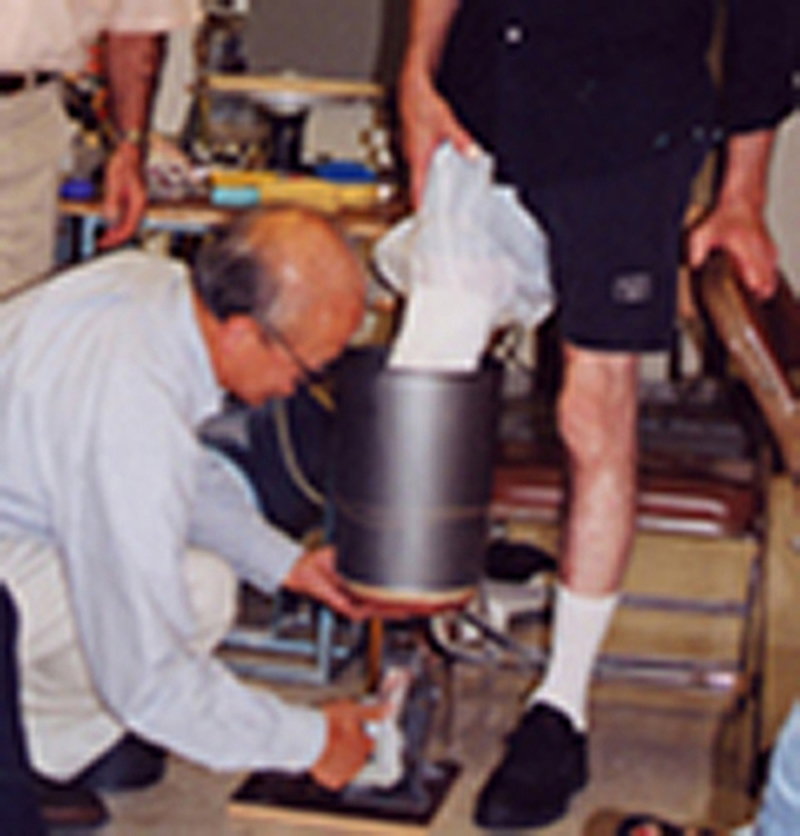
For his commitment to the art and science of physical medicine and his contribution to cultural enrichment through his art, we proudly name Dr. Yeongchi Wu this month's Virtual Mentor physician role model.
Wolinsky H. New prostheses allow wearers more mobility. Chicago Tribune. March 1, 1993; Medlife: 3.
Condor B. Physician and sculptor Yeongchi Wu finds healing arts and fine art occupy common ground. Chicago Tribune. Sept. 11, 1997; Tempo 1.